
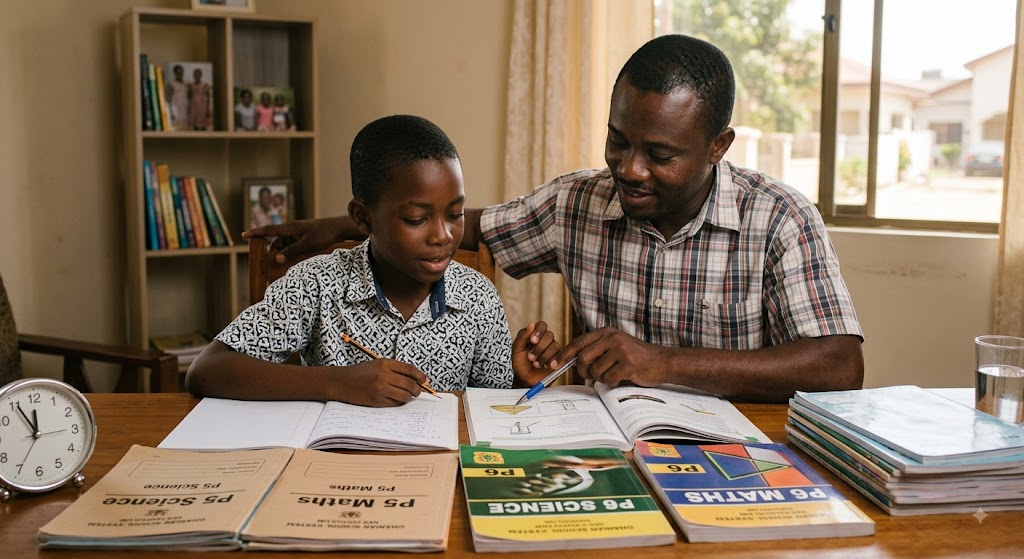
Every back-to-school season, the same thing happens in homes across Ghana. A child who was comfortably at the top of their class in July walks into a new classroom in September and suddenly feels lost. New teacher, new textbooks, new expectations, and a curriculum that assumes they remember everything from the term before.
Most parents wait for report cards to find out if their child struggled with the jump. By then it’s October, sometimes November, and the child has already spent weeks feeling behind. Real back-to-school preparation starts before the term does, not after the first bad test comes home.
Here’s what actually helps your child prepare for their new class this term.
READ ALSO: Is Your Child Wasting Their Saturday? Here Is What to Do Instead
Back to school preparation starts with knowing exactly where the gaps are
“My child needs to work on Maths” is not specific enough to act on. Does your child struggle with fractions, or with word problems, or with long division? A P4 pupil who can’t yet handle multi-step word problems is going to hit trouble the moment P5 Maths introduces more of them, even if their basic arithmetic is fine.
Sit with your child’s last exercise books and past class tests. Look for the specific topic where marks dropped, not just the overall subject. That’s the topic to target before September, not a general “revise everything” plan that burns out the child and fixes nothing specific.
Revise the end of the old syllabus, not the beginning
Parents often start revision from the beginning of the term that just ended, because that’s what feels familiar. But the topics taught in June and July are the ones that get built on immediately in September. A JHS2 student who never fully grasped simultaneous equations in Term 3 is going to struggle the first week JHS3 Maths references them. Start revision from the most recent topics and work backwards, not forward.
Read ahead, just a little
You don’t need to teach the whole next-class syllabus over the holidays. But spending even thirty minutes looking at the first two or three topics of the new term means your child walks into class recognizing the material instead of meeting it cold. For JHS students moving toward BECE years especially, this small head start compounds. A JHS2 student who’s seen the shape of JHS3 topics in August adapts faster in September than one who hasn’t.
Practice under timed conditions, not just untimed homework
A child can know the material and still struggle because they’ve never practiced answering under time pressure. This matters most going into JHS3, where BECE-style timing becomes the norm. If your child has spent two years doing homework with no time limit and suddenly faces a 45-minute test, the timing itself becomes the obstacle, not the content. Build in short timed quizzes during the holidays so the pressure isn’t a surprise later.
Every transition has its own pressure point
Back to school prep isn’t the same for every child, because every jump between classes has its own trouble spot.
Moving from P5 to P6 usually means the first real taste of exam-style pressure, since P6 is where teachers start preparing pupils for the transition into JHS. Moving from JHS1 to JHS2 is where subjects stop being introductory and start building toward BECE, so gaps that seemed small in JHS1 start to matter. And moving into JHS3 is its own category entirely. This is BECE preparation territory, and a child who starts the year with unresolved gaps from JHS2 is starting the most important academic year of junior high already behind.
Ask what specific jump your child is making this term, and target your back to school revision at that jump, not at “class work” in general.
Don’t skip the subjects that feel “easy”
Parents naturally focus revision time on the subject their child struggled with. But a child who was strong in English in P5 can still lose ground over an eight-week break simply from not reading or writing regularly. Skills like comprehension and composition fade faster than most parents expect. A short daily habit, even fifteen minutes of reading or one paragraph of writing a day, keeps that ground from slipping.
READ ALSO: 10 Years of BECE Questions Analysed: What the Data Says Will Come Up – Class at Home
Back to school vacation classes at Class at Home
This is exactly why our vacation classes run through the break rather than stopping the moment the term ends. Students get structured revision on the topics that actually carry into the new class, practice quizzes that mirror what they’ll face in September, and a head start on the new syllabus instead of a cold start. Whether your child is heading into a new primary class or preparing for BECE, our online tutoring is built around closing the specific gaps that matter for that transition, not generic revision.
If you want your child to walk into their new class ahead instead of catching up, now is the time to start back to school prep, not the first week of the new term when the gaps have already shown up on a test.
You can register your child now.