
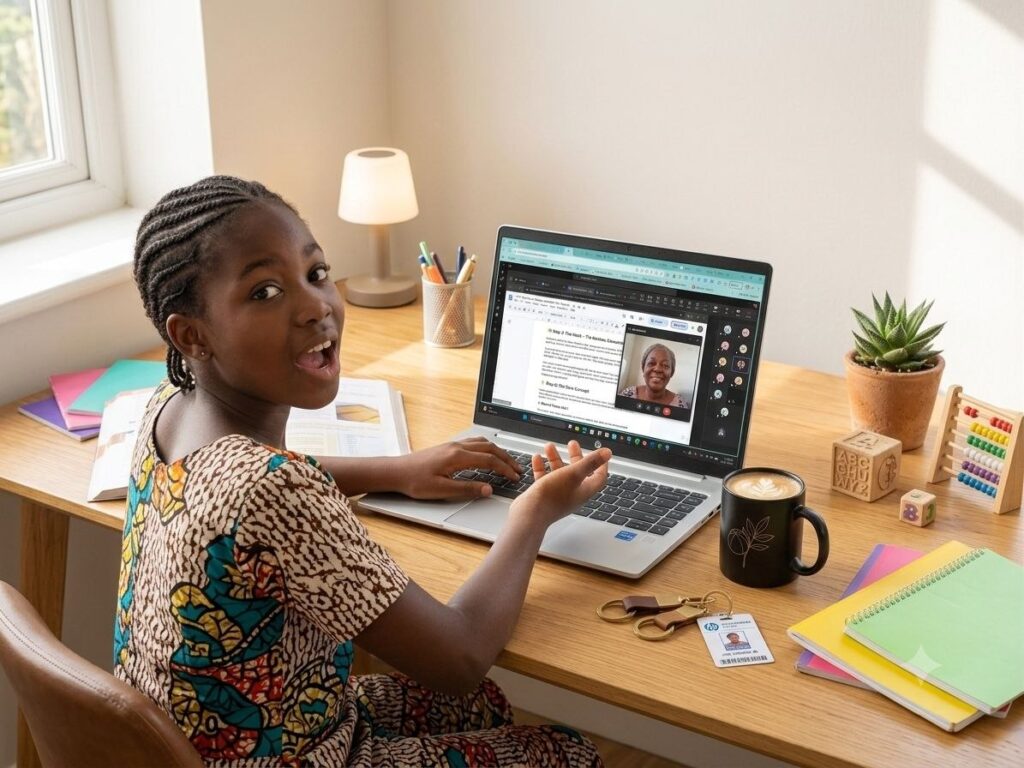
Every long school break, Ghanaian parents face the same quiet dread. The term ends, the uniforms go into storage, and suddenly there are eight or nine weeks of open time to fill, and a phone that’s always within reach.
You know the pattern. Week one, the excitement of “no school” is real. By week three, the phone has become the default. By the time September comes around, your child is back in a classroom, but their mind isn’t quite back in gear. Teachers call it the “summer slide,” that quiet loss of academic sharpness that happens when learning stops for two months straight. It’s not laziness. It’s just what happens when structure disappears.
The good news is that this isn’t actually a hard problem to solve. It just needs the right kind of vacation programme, one built for how children actually learn, not just something to keep them “busy.”
What a good vacation class should actually do
Most vacation programmes fall into one of two traps. Either they’re a loose repeat of what your child already knows, which is comfortable but doesn’t move them forward, or they’re so packed and generic that your child dreads them by week two.
A vacation class only earns its place in your child’s holiday if it does three things:
- Prepares them for what’s coming, not what’s already done. Your child was just promoted to a new grade. The next eight weeks are the best possible window to get them ready for it, quietly, before the pressure of a new term begins.
- Gives the holiday real shape. Children (and honestly, most adults too) do better with rhythm. Knowing that Monday is Maths, Tuesday is English, gives a vacation the kind of structure that makes idle scrolling less appealing, not because it’s banned, but because there’s something better to look forward to.
- Teaches something school doesn’t have time for. A packed school-term timetable rarely leaves room for coding, online safety, or how to pitch a business idea. The holidays are exactly when there’s space for that.
Why Class at Home’s version works
This is the thinking behind Class at Home’s Online Vacation Classes, running 27th July to 4th September for children in Lower Primary through JHS.
Here’s what makes it different from a typical holiday club:
It’s built around the grade your child is moving into, not the one they just left. Every Maths, English, and Science session is designed around what your child will actually need when they resume school in their new grade. It’s not revision for revision’s sake; it’s a genuine head start.
Four classes a week, same days, same rhythm. Maths on Monday, English on Tuesday, Science on Thursday, and Digital Skills on Friday, one hour each, at a time matched to your child’s age group. That predictability is what turns a vacation from “unstructured time” into something your child can actually look forward to finishing.
Fridays go somewhere school doesn’t. Over a five-week rotation, children work through STEM challenges, online safety, entrepreneurship, graphic design, and even coding and AI, all built around Ghanaian examples, from MTN MoMo to the Akosombo Dam. It’s the kind of practical, modern skill-building most school timetables simply don’t have room for.
It respects how different age groups actually learn. Lower and Upper Primary children get a slower, visual, teacher-led pace with a parent encouraged to sit alongside. JHS students get a faster, more independent pace with real exam-style practice, closer to what they’ll meet in SHS. Nobody is squeezed into a one-size-fits-all class.
It fits into real family life. Everything runs online, so there’s no commute eating into the holiday. Sessions are recorded, so if your child misses a class (a family trip, a network issue, a sick day), they’re never left behind. And at GHC 300 per child for the entire eight-week run, it’s priced to be a genuine option, not a luxury.
The real shift parents notice
Parents who’ve been through a Class at Home vacation programme tend to describe the same shift: it’s not just about grades, it’s about how the holiday feels as a family. One Accra parent noticed her son’s Maths teacher comment on how much sharper he seemed after the break. A Kumasi parent watched her daughter build her first Scratch game and design her own logo on a Friday, while the weekday classes quietly got her ready for JHS 1. A Tamale parent put it simply: her children now look forward to Monday, Tuesday, Thursday, and Friday, instead of losing the whole break to a screen.
That’s really the point. A vacation shouldn’t be something your child needs to recover from once school resumes. It should be time that builds them up, a little sharper, a little more confident, a little more ready, so the first week of the new term feels like a continuation, not a scramble to catch up.
If you’re deciding for this vacation
Spaces are limited per class group, and the programme is already running through 4th September. If you’d like your child to spend this break moving forward instead of just filling time, you can enrol here or ask a question on WhatsApp. Replies come within two hours.
Your child’s next grade starts the moment this holiday does.