
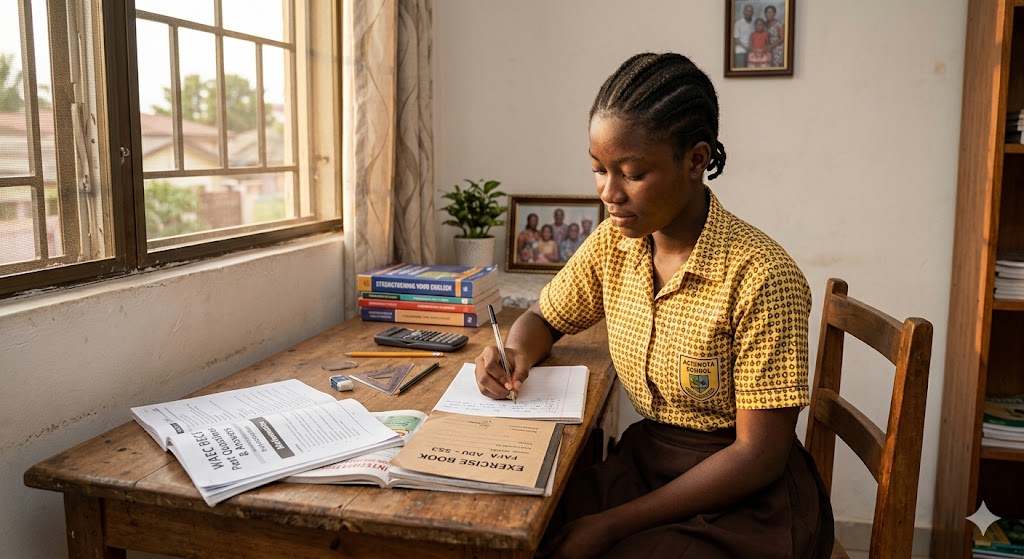
There is a question every serious JHS 3 student asks at some point, and most parents ask it too:
What is actually going to come up in the BECE?
It sounds like wishful thinking, the kind of question that only gets answered by buying a dubious ‘leaked paper’ from someone at the Makola.
But here is what most students do not realise: you do not need a leaked paper.
The BECE examiner has, in a sense, already told you what is coming through decades of consistent, patterned past questions.
We analysed BECE past questions across all four core subjects from 2015 through 2025. What we found is not surprising to experienced educators, but it is genuinely useful to students who have not studied the patterns: certain topics appear almost every single year. Others rotate predictably on a two- to three-year cycle. A handful are perennial favourites that have not missed a paper in over a decade.
This is not a prediction post in the cheeky sense. We are not claiming to know what WAEC will set in the upcoming BECE. What we are doing is something more useful: presenting 10 years of evidence so you can make intelligent decisions about where to invest your preparation time.
Let us go subject by subject.
1. Mathematics: What the data says about BECE Mathematics
Mathematics is examined in two papers: Paper 1 (objective, multiple-choice) and Paper 2 (essay, requiring written working). Across 10 years of past questions, the following picture emerges clearly.
Topics that appear every single year, without exception
Word problems. Every BECE Mathematics paper, without exception, includes word problems — scenarios drawn from everyday Ghanaian life where you must read, extract the mathematical information, and solve. Examples include problems involving buying and selling, profit and loss, workers sharing wages, mixing quantities, and calculating times and distances. Students who cannot bridge written English and mathematical operations struggle badly here. This is the single most consistently tested skill in the paper.
Fractions, percentages and ratios. These appear in virtually every Paper 1 and frequently anchor Paper 2 questions. Expect to calculate percentage profit or loss, share amounts in given ratios, convert between fractions and percentages, and work with mixed numbers. These are basic operations — but they trip up an enormous number of candidates every year because of careless errors under pressure.
Algebra — simplification and linear equations. Every year features algebraic simplification (collecting like terms, expanding brackets, factorising) and solving for x in linear or simultaneous equations. The 2023 and 2024 papers both included substitution into formulae. Paper 2 regularly features a question that asks you to ‘solve for x’ as part of a multi-step word problem.
Statistics and data interpretation. Reading and interpreting bar charts, pie charts, histograms, and frequency tables is a near-permanent feature of the paper. Calculating mean, median, mode, and range from a data set has appeared in nine of the last ten papers. This is an area where students who practise consistently pick up reliable marks.
Topics that appear most years (8–9 out of 10)
- Geometry: angles in triangles, parallel lines, polygons, and angle properties
- Mensuration: area and perimeter of rectangles, triangles, circles, and trapeziums; volume of prisms and cylinders
- Transformations: translation, reflection, rotation, and enlargement on a coordinate plane
- Vectors: column vectors, addition, subtraction, and finding resultants
- Sets and Venn diagrams: union, intersection, complement, and number-of-elements problems
- Trigonometry: SOHCAHTOA applied to right-angled triangles; heights and distances
Topics on a regular rotation (6–7 out of 10)
- Constructions: angles and triangles using compass and ruler — appeared 2016, 2017, 2018, 2019, 2021, 2023 (not 2020, 2022, or 2024, making it due again)
- Bearings: compass bearings, true north, and finding distances using trigonometry
- Number bases: converting between binary, decimal, and other bases
- Indices and surds: laws of indices, simplifying surds
The Mathematics likelihood table
| Topic | Appeared (2015–2025) | 2027 likelihood |
| Word problems (profit/loss, sharing, mixing) | Every year (10/10) | Very high |
| Fractions, percentages and ratios | Every year (10/10) | Very high |
| Algebra: simplification and equations | Every year (10/10) | Very high |
| Statistics: mean, median, charts | 9 of 10 years | Very high |
| Geometry: angles in shapes | 9 of 10 years | Very high |
| Mensuration: area and volume | 8 of 10 years | Very high |
| Transformations and vectors | 8 of 10 years | High |
| Sets and Venn diagrams | 8 of 10 years | High |
| Trigonometry (SOHCAHTOA) | 7 of 10 years | High |
| Construction with compass and ruler | 6 of 10 years | High |
| Bearings | 6 of 10 years | High |
| Number base conversion | 5 of 10 years | Moderate |
What this means for your Mathematics preparation
Do not spend all your time on construction just because it came up in 2023. The examiner almost certainly rotates it. The reliable marks — the ones that will actually determine your grade, sit in word problems, algebra, statistics, and fractions. These appear every year. Master them first.
Show your working on every Paper 2 question. Always. A wrong final answer with clear, correct working still earns marks. A correct answer with no working earns nothing if the examiner suspects you guessed.
2. Integrated Science: What the data says about BECE Integrated Science
Integrated Science is the broadest of the four core subjects, spanning biology, chemistry, and physics. But breadth does not mean unpredictability. The past ten years of BECE Science papers reveal a remarkably consistent set of topics that return, in slightly varied forms, almost every year.
The topics that almost never miss
Photosynthesis and respiration. This is the single most-tested topic in BECE Science — it has appeared in every paper from 2015 to 2025, sometimes twice in the same paper. Examiners ask students to state the word equation, identify the inputs and outputs, explain the conditions required, distinguish photosynthesis from respiration, and describe the structure of the leaf. Know every detail of both processes. If you know nothing else in Biology, know this.
Cells — structure and function. Cell structure questions appear in nine of the last ten papers. Examiners ask for diagrams of plant and animal cells, functions of organelles (nucleus, mitochondria, chloroplast, cell membrane, cell wall, vacuole), and the differences between plant and animal cells. The chloroplast-photosynthesis link is asked almost every year in one form or another.
Human body systems. The digestive system and respiratory system appear most consistently. Questions on the circulatory system, nervous system, excretory system, and reproductive system appear on a rotation. In a given year, expect at least two human biology questions. Know the organs, their functions, and the overall process for each system.
Acids, bases, salts, and neutralisation. Chemistry topics are anchored by acid-base chemistry. The pH scale, properties of acids and bases, the neutralisation equation (Acid + Base → Salt + Water), litmus tests, and examples of common acids and bases (hydrochloric acid, sulphuric acid, sodium hydroxide) appear regularly. The 2022, 2023, and 2024 papers all featured acid-base content.
Electricity — Ohm’s Law and circuit calculations. Physics in the BECE often comes down to electrical calculations. Ohm’s Law (V = IR), total resistance in series and parallel circuits, and calculating current or voltage in a circuit have appeared in eight of the last ten papers. These questions are marks waiting to be collected if you can handle the arithmetic confidently.
Topics on a strong regular rotation
- Reproduction: sexual and asexual in plants, human reproduction, STIs (HIV/AIDS consistently mentioned)
- Mixtures and separation methods: filtration, evaporation, distillation, chromatography, magnetic separation
- Force, work, and machines: Newton’s laws, simple machines, mechanical advantage
- States of matter and changes of state: melting, freezing, evaporation, condensation
- Diseases: malaria, cholera, tuberculosis — causes, transmission, prevention, treatment
- Soil and the environment: types of soil, soil erosion, conservation, water/carbon/nitrogen cycles
- Plant reproduction and pollination: agents, seed dispersal methods, flower structure
- Diffusion and osmosis: definitions, demonstrations, real-life examples
- Heat transfer: conduction, convection, radiation — with examples
Topics that appeared in recent papers (2022–2025) and are worth close attention
- Carbon cycle and nitrogen cycle — appeared in 2024 WAEC sample questions; gaining prominence under the new curriculum
- Refraction of light — the 2025 BECE included light refraction (bending of light from one medium to another, how the eye focuses)
- Metamorphosis — complete vs incomplete; the grasshopper as an example of incomplete metamorphosis, appeared in 2024 WAEC samples
- Hay making and animal production — appeared in 2024, indicating agriculture topics are on the examiner’s radar
- Basic electronics (diodes, p-type and n-type semiconductors) — appeared in 2025 questions, reflecting the new curriculum
The Integrated Science likelihood table
| Topic | Appeared (2015–2025) | 2027 likelihood |
| Photosynthesis and/or respiration | Every year (10/10) | Very high |
| Cell structure: plant vs animal | 9 of 10 years | Very high |
| Human digestive or respiratory system | 9 of 10 years | Very high |
| Acids, bases, salts and neutralisation | 9 of 10 years | Very high |
| Electrical circuits: Ohm’s Law and calculations | 8 of 10 years | Very high |
| Reproduction: plants and/or humans | 8 of 10 years | High |
| Mixtures and separation methods | 8 of 10 years | High |
| Diseases: malaria, cholera, HIV/AIDS | 7 of 10 years | High |
| Force, work, and simple machines | 7 of 10 years | High |
| Soil, environment and water cycle | 7 of 10 years | High |
| Carbon / nitrogen cycles | 5 of 10 years, rising trend | High |
| Refraction and optics (light) | 4 of 10 years, rising trend | Moderate-High |
What this means for your Science preparation
Photosynthesis, cells, and electrical calculations are the three areas you cannot afford to be vague on. Know them completely. For the rest, prioritise the topics that connect to human life and the environment — these align with the new Common Core curriculum’s emphasis on real-world application.
On exam day, use precise scientific vocabulary. ‘The green stuff in leaves’ costs you marks. ‘Chlorophyll, located in the chloroplast’ earns them. Technical language is not showing off — it is what the marking scheme expects.
3. Social Studies: What the data says about BECE Social Studies
Social Studies is the subject where students most often underestimate what is required. Reading through your notes is not enough. The BECE examiner wants you to analyse, evaluate, and explain — not just recall. But knowing the topics that consistently appear gives you a strong foundation to build that analytical skill on.
Topics that anchor every paper
Ghana’s independence and colonial history. This is the most consistently tested area in Social Studies. Questions on the independence movement, the role of Kwame Nkrumah, the founding of the CPP, Ghana’s independence in 1957, the formation of the First Republic in 1960, and the significance of being Africa’s first sub-Saharan independent nation have appeared in eight of the last ten papers. Know the key dates, figures, and the sequence of events leading from colonial rule to independence.
Ghana’s Constitution and system of government. The 1992 Constitution — its key features, the separation of powers (executive, legislative, judiciary), fundamental human rights, and the rule of law — appears in almost every paper. Students are also regularly asked about democratic governance, the role of the Electoral Commission, and the rights and responsibilities of citizens.
Environmental issues and degradation. Galamsey (illegal small-scale mining), deforestation, water pollution, and the destruction of farmland are consistently tested — both as objective questions and as essay topics. This is an area where current affairs and the curriculum converge. WAEC examiners use the environment as a recurring lens for discussing development challenges in Ghana. Students who can connect specific examples (rivers destroyed by galamsey, forest loss in the Brong-Ahafo region) to general principles will score higher.
Map reading skills. Map components — scale, legend (key), cardinal and intercardinal points, conventional signs — appear in the objective test in almost every year. Paper 2 questions have asked students to describe how they would use a map for a specific purpose (such as a class outing or a community survey). The 2024 WAEC sample questions and the 2024 actual paper both featured map-reading questions.
Topics on strong regular rotation
- Pre-colonial states of Ghana: the Ashanti, Fante, Dagomba, Gonja, and other traditional states — their formation, governance, and relationships
- ECOWAS: formation (1975), headquarters (Abuja), purpose, member states, and achievements
- Population and census: why population census is conducted, how it is used in planning, Ghana’s census history
- Natural resources of Ghana: minerals (gold, bauxite, manganese, diamond, oil), agricultural resources, timber
- Social issues: teenage pregnancy, HIV/AIDS, drug abuse, child labour — causes, effects, and solutions
- Socialisation: how individuals learn cultural values, roles of family, school, and community
- West African geography: major rivers (Volta, Niger, Senegal), lakes (Volta, Chad, Nasser), countries and capitals
- Economic activities: farming systems in Ghana, fishing, mining, industries — and their contributions to national development
Emerging topics gaining prominence under the new curriculum
- Volunteerism and community development — appeared in 2024 mock and sample questions; reflects CCP’s emphasis on civic participation
- Conflict resolution and mediation — featured in 2024 papers; peaceful resolution vs violent responses
- Digital economy and ICT in Ghana’s development — a newer area being introduced through the CCP syllabus
- Climate change and its effect on Ghanaian agriculture — consistent with environmental degradation theme but now framed through climate lens
The Social Studies likelihood table
| Topic | Appeared (2015–2025) | 2027 likelihood |
| Ghana’s independence: 1957, Nkrumah, the CPP | 9 of 10 years | Very high |
| Ghana’s 1992 Constitution and government structure | 9 of 10 years | Very high |
| Environmental degradation (galamsey, deforestation) | 9 of 10 years | Very high |
| Map reading: scale, legend, cardinal points | 9 of 10 years | Very high |
| ECOWAS: formation, purpose, member states | 8 of 10 years | High |
| Pre-colonial states of Ghana | 7 of 10 years | High |
| Population: census, distribution, migration | 7 of 10 years | High |
| Social issues: HIV/AIDS, child labour, drugs | 8 of 10 years | High |
| Natural resources and economic activities | 7 of 10 years | High |
| Conflict resolution | 4 of 10 years, rising | Moderate-High |
What this means for your Social Studies preparation
Do not just read the content — practise writing. The essay section of Social Studies is where marks are won or lost, and many students know the content but cannot structure a response under timed conditions. Use past essay questions to practise writing a clear introduction, body paragraphs with specific evidence, and a conclusion. You have roughly 25 minutes per essay question. Practise writing to time.
For objective questions, pay attention to the exact wording. ‘Which of the following is NOT…’ questions are common in Social Studies and catch students who read too quickly.
What the data says about BECE English Language
English Language is the most predictable of the four core subjects in terms of structure. The paper format has remained stable for years, and the examiner follows clear, consistent patterns — particularly in the essay section, which most students find the most daunting.
The alternating formal/informal letter pattern
This is one of the most useful patterns in the entire BECE. The English Language Paper 2 essay section regularly features a letter-writing question, and WAEC alternates between formal and informal letters in a clear, trackable pattern.
Reviewing the years from 2010 to 2025:
- Formal letters: 2023, 2020, 2019, 2018, 2014, 2012, 2011
- Informal letters: 2024, 2022, 2021, 2017, 2016, 2015, 2013
The pattern: WAEC broadly alternates between formal and informal, with occasional two-year informal streaks (2021–2022, 2015–2016). Following this pattern, the 2025 BECE most likely featured a formal letter (coming after 2024’s informal). If that holds, the next exam is positioned for informal — but given the two-year streak pattern, either could appear. The safest preparation strategy is to master both formats completely. If you only know one, you are gambling with your grade.
Essay types that rotate
Article for publication. Appeared in 2020 (harmful effects of examination malpractice), 2018 (reasons students should cultivate reading habits), and 2016 (environmental degradation from mining). Articles for national newspapers or school magazines are a consistent option in the essay section. Topics tend to be civic in nature — social problems, education, national development.
Narrative/story writing. Stories that end with a given sentence or illustrate a theme have appeared several times in the past decade, including 2024 (‘a story that ends with So it pays to be kind to strangers’) and 2016 (‘a story ending with: We were lucky that night’). Note that WAEC explicitly does not accept stories with animal characters (e.g. Ananse stories) for this question type.
Descriptive composition. Describing a person, event, place, or experience. These appear as alternatives in the essay section and favour students who can write with specific, sensory detail.
Speech or debate. Writing a speech arguing for or against a motion has featured in several past papers. Students need to know the format: addressing the chairperson, opposing team, and audience; presenting arguments in clear numbered points; concluding with a direct statement of position.
What consistently appears in Paper 1 (Objective/Comprehension)
- Comprehension passage followed by specific questions — appears every year; passages are usually from Ghanaian or African fiction or non-fiction prose
- Summary questions: summarise the argument of a passage in a given number of words or sentences — introduced more explicitly under the new curriculum
- Grammar: tenses (especially past simple, past perfect, and present perfect), reported speech, subject-verb agreement, articles (a/an/the), and error identification
- Vocabulary in context: selecting the word that best fits a sentence based on meaning
- Word formation: turning nouns to verbs, verbs to adjectives, and so on
Likely essay themes based on 10-year topic trends
WAEC tends to select essay topics that reflect current social concerns in Ghana. Based on what has been tested in recent years and what is topical in Ghanaian life, the following themes are worth preparing for:
- The benefits or harms of social media for young people
- Environmental pollution and what citizens should do about it
- The importance of education for girls in Ghana
- Examination malpractice: causes, effects, and remedies
- The role of young people in national development
- A formal letter requesting support, reporting a problem, or expressing concern to an authority
The English Language likelihood table
| Topic | Appeared (2015–2025) | 2027 likelihood |
| Letter writing (formal or informal) | Every year (10/10) | Very high |
| Comprehension passage + questions | Every year (10/10) | Very high |
| Summary writing | Every year (10/10 — stronger in new curriculum) | Very high |
| Grammar: tenses, reported speech, articles | Every year (10/10) | Very high |
| Article for publication in a newspaper/magazine | 6 of 10 years | High |
| Narrative / story with a given ending | 5 of 10 years | High |
| Speech or debate writing | 4 of 10 years | Moderate-High |
| Descriptive composition | 4 of 10 years | Moderate |
What this means for your English preparation
Practise writing. This sounds obvious but it is the most skipped part of English preparation. Reading about essay structure without writing under timed conditions is like studying swimming theory without getting in the pool. Write a full letter — both formal and informal format — at least twice before exam day. Write at least one article for publication. Practise your comprehension technique: read the passage twice, then answer questions in complete sentences.
Master the format distinctions: formal letters have a different layout, salutation, and closing from informal ones. Mixing them up in the exam is an unnecessary error that costs marks.
The big picture: what do these 10 years of patterns tell us?
Looking across all four core subjects, three things stand out.
First, the reliable marks are predictable. Word problems in Maths, photosynthesis in Science, Ghana’s independence in Social Studies, and letter writing in English are not surprises — they are the foundation of the exam. Students who have genuinely mastered these areas already have a significant portion of their aggregate secured before they even sit down.
Second, the new curriculum is reshaping emphasis — slowly but visibly. WAEC has been transitioning to the Common Core Programme (CCP) syllabus, which emphasises critical thinking, application, and real-world reasoning over rote recall. This means questions are increasingly framed as scenarios (interpreting data about malaria cases in hospitals, analysing the impact of galamsey on a community) rather than simple factual recall. Students who practise applying knowledge — not just memorising it — will have an edge.
Third, the topics that are ‘due’ matter. Construction in Mathematics has missed recent papers after years of appearance — it is arguably overdue. The carbon cycle and refraction have appeared in recent WAEC sample questions and the 2024–2025 papers, signalling increased focus. Map reading in Social Studies has been present in both the official 2024 sample release and the actual paper. These ‘due and rising’ topics deserve specific attention.
Your action plan based on this analysis
- In Mathematics, ensure you can handle word problems confidently. Practise translating written scenarios into equations. Time yourself.
- In Science, be able to write the full photosynthesis equation from memory, draw and label a cell accurately, and solve a basic Ohm’s Law calculation. These three alone account for a large portion of available marks.
- In Social Studies, write at least two practice essays — one on Ghana’s independence and one on environmental degradation. These topics are almost certain to appear in some form.
- In English, write one formal letter and one informal letter under timed conditions this week. Note the differences in layout, salutation, and closing.
- Review topics that have not appeared in recent papers — construction in Maths, refraction in Science — as these have a rotation pattern that suggests they are overdue.
- Practise past questions from 2019 onwards under exam conditions. The pattern of how questions are asked has evolved under the new curriculum and the most recent papers reflect the current standard.
| At ClassAtHome, our extra classes are built around exactly this kind of pattern analysis. Our tutors teach students what the examiner wants to see — not just the content, but how to express it under timed conditions. Enrol now. classathome.co/extra-classes-signup |
A final thought
There is no such thing as a leaked paper that will tell you exactly what WAEC will set on the day. Anyone selling you that is selling you a risk, not an advantage.
But there is something better than a leaked paper: ten years of evidence. The BECE examiner has been predictable. The patterns are there for anyone who takes the time to look at them seriously.
Now you have looked. Use what you have seen.
The students who combine this kind of strategic pattern awareness with consistent, disciplined preparation are the ones who walk into that exam hall confident — not because they got lucky, but because they did the work.
Go and do the work.