
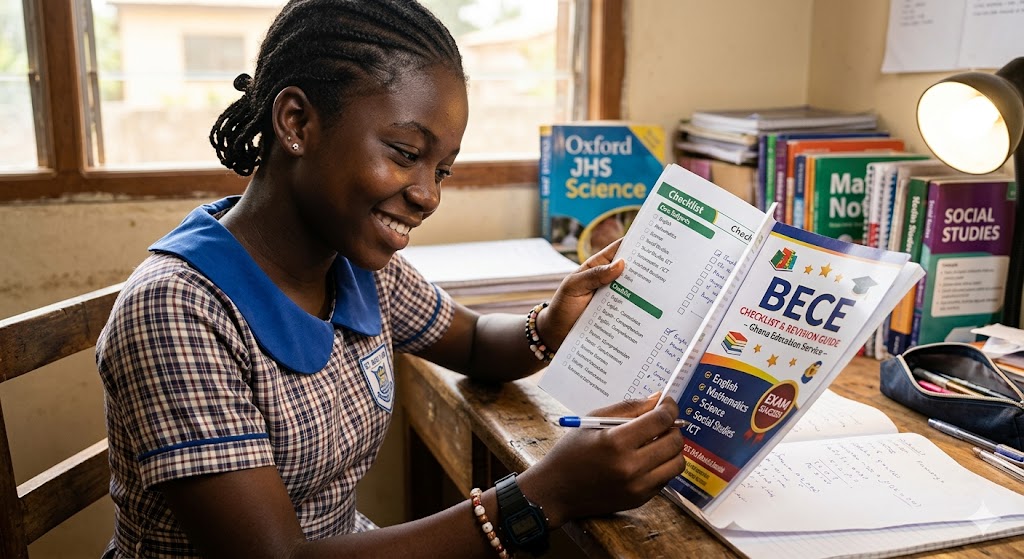
There is a particular kind of anxiety that sets in when you look at everything you are supposed to know for the BECE and realise you cannot quite tell where to start. The syllabus feels enormous. Every subject feels equally urgent. And because you cannot tackle everything at once, some students end up doing nothing.
This article is designed to fix that.
What follows is a subject-by-subject breakdown of exactly what the BECE covers, what topics come up most consistently, and what you should prioritise with the time you have left. Whether you are a JHS 3 student doing a final check or a parent trying to understand what your child is facing, work through this carefully.
Print it. Put it on the wall. Use it as a physical tracker. Cross things off as you go.
The structure of the BECE: a quick reminder
Every BECE candidate writes eight to nine subjects in total. Four of these are compulsory for everyone. The remaining subjects are a mix of electives and a language option.
The four compulsory core subjects are:
English Language — examined in two papers: Paper 1 (objectives/comprehension) and Paper 2 (composition/essay and literature based on The Cockcrow)
Mathematics — examined in two papers: Paper 1 (objective) and Paper 2 (essay/long answer)
Science — one paper combining biological, physical, chemical, and earth sciences
Social Studies — one paper covering Ghana and West African environment, governance, geography, economics, and civic education
Beyond the core four, candidates also write:
Religious and Moral Education (RME) — covering Christianity, Islam, and traditional Ghanaian religion
Computing — covering theory and practical components of digital literacy and technology
Career Technology — combining elements of home economics, basic agriculture, and technical skills
Creative Arts and Design — covering design principles, visual arts, music, and performing arts
Ghanaian Language — an elective subject covering the specific local language taught at your school (e.g., Twi, Ga, Ewe, Fante)
French or Arabic — optional foreign language subjects, depending on what your school offers
Your aggregate is calculated from your best six grades. That is why consistent performance across subjects matters — and why neglecting any subject entirely is a risk.
Core subject 1: English Language
English is arguably the most important subject in the BECE, not just because it is compulsory but because it underpins your ability to express yourself in every other paper. Examiners across all subjects reward clear, correct English.
What to cover:
- Comprehension passages: Read passages carefully and practise answering specific questions. Examiners want concise, direct answers that address what was actually asked.
- Summary writing: Identify the key points from a passage and reduce them to a specified number of words or sentences. Practise cutting without losing meaning.
- Essay writing: You will typically choose one essay type from several options — narrative, descriptive, argumentative, or expository. Know how to structure all four. Introduction → body paragraphs with clear points → conclusion.
- Letter writing: Formal and informal letters appear regularly. Know the correct format for both: formal letters require your address, date, recipient details, and a formal sign-off. Informal letters are warmer but still structured.
- Grammar and usage: Articles, tenses, subject-verb agreement, punctuation, and sentence construction. Keep a list of common errors and eliminate them from your writing.
- Vocabulary: Words are tested in context. Read regularly to build vocabulary naturally.
One specific thing to note: in Paper 2, examiners are reading for both what you say and how you say it. A grammatically correct essay with a clear structure will outscore a brilliant idea that is badly expressed.
Core subject 2: Mathematics
Mathematics in the BECE is structured across two papers. Paper 1 is multiple choice and rewards speed and accuracy with core concepts. Paper 2 requires you to show your working and communicate your reasoning.
What to cover:
- Number and numeration: Fractions, decimals, percentages, ratios, indices, and number bases. These appear in almost every past paper.
- Algebra: Simplifying expressions, solving linear equations, substitution, and changing the subject of formulae. Algebraic word problems are very common.
- Geometry: Properties of shapes, angles (parallel lines, triangles, polygons), and construction using a ruler and compass.
- Mensuration: Area and perimeter of plane shapes; surface area and volume of solids. Know your formulae and practise applying them to real-world scenarios.
- Statistics and probability: Reading and drawing bar charts, pie charts, frequency tables, and histograms. Mean, median, mode, and range. Basic probability.
- Trigonometry: SOHCAHTOA — sine, cosine, and tangent — applied to right-angled triangles. Heights and distances.
- Vectors and transformations: Column vectors, resultant vectors, translation, reflection, rotation, and enlargement.
The golden rule in Maths: always show your working. Even a wrong final answer can earn marks if the process is correct and clearly shown. Never skip steps.
Core subject 3: Integrated Science
Integrated Science tends to intimidate students because it covers so much ground. But the examiners follow the syllabus closely, and past questions reveal clear patterns in what comes up. (See our dedicated article on Integrated Science for a full breakdown of the highest-priority topics.)
What to cover:
- Living things and cells: Cell structure and function, differences between plant and animal cells, cell division.
- Classification of living things: The five kingdoms, classification of plants and animals, adaptations.
- Photosynthesis and respiration: Conditions, equations, differences, and importance. These two processes appear in almost every year’s paper.
- Human biology: Nutrition and digestion, the circulatory system, excretion, reproduction, the nervous system, and diseases.
- Reproduction in plants: Sexual and asexual reproduction, pollination, fertilisation, seed dispersal.
- Physical science: States of matter and changes, acids and bases, mixtures and separation methods, chemical reactions.
- Force, energy, and machines: Newton’s laws, simple machines, energy types and conversion, work and power.
- Electricity: Series and parallel circuits, electrical calculations, safety. Calculations are very common here.
- Environment: Pollution types and effects, conservation, the water cycle, weather and climate.
Science answers must be precise. Use the correct technical vocabulary. Saying ‘the green stuff in leaves’ when you mean chlorophyll will lose you marks.
Core subject 4: Social Studies
Social Studies is one of the subjects many students underestimate because it feels like ‘just reading.’ In reality, it rewards students who can not only recall information but analyse and evaluate it — a skill that takes practice.
What to cover:
- Ghanaian history: Pre-colonial states (Ashanti, Fante, Dagomba etc.), colonial rule, the independence movement, and the role of figures like Kwame Nkrumah and J.B. Danquah.
- Government and civic education: The three branches of government, the 1992 Constitution, human rights, citizenship responsibilities.
- West African history and ECOWAS: Formation and purpose of ECOWAS, key events in West African history.
- Geography: Population and settlement, economic activities, physical geography, natural resources.
- Social issues: Poverty, corruption, child labour, teenage pregnancy, HIV/AIDS — these appear as essay or discussion topics.
For Social Studies essays, use the standard structure: a clear introduction that states your position, body paragraphs that each make a distinct point, and a conclusion. Back up your points with facts and examples where you can.
READ ALSO: No Pressure — But Here’s Everything You Need to Know to Ace the BECE
Elective subjects: what to focus on
Religious and Moral Education (RME)
RME covers three religious traditions: Christianity, Islam, and African Traditional Religion. Know the core beliefs, practices, festivals, and moral teachings of each, alongside modern civic and moral values. Essay questions often ask you to ‘compare’, ‘discuss the importance of’, or ‘explain the application’ of certain moral virtues in daily life — practise writing well-structured responses.
Computing
Computing is examined in both theory and practical components, focusing on digital literacy. Topics cover: computer hardware, software, operating systems, data security, word processing, spreadsheets, internet research, and introduction to basic coding concepts. The paper requires you to demonstrate actual skills and apply concepts to real-world scenarios. Regular hands-on practice in a computer lab is essential.
Career Technology
Career Technology combines elements of home economics, basic agriculture, and technical skills. You will be tested on technical drawing (such as orthographic and isometric drawing), proper use of tools, materials, and basic designing/making of items. Accuracy and safety are critical in this subject. Practise your drawing with proper instruments, and study the practical steps for food preparation, clothing, and building artifacts.
Creative Arts and Design
Creative Arts and Design explores design thinking, visual arts (drawing, painting, sculpting), and performing arts (music, dance, drama). You will need to understand the elements and principles of design, cultural heritage in art, and how to express ideas creatively. Be prepared for both theoretical questions and practical design tasks.
Ghanaian Language / French / Arabic
For your chosen Ghanaian Language, focus deeply on the grammar, comprehension, customs, and the rich cultural content relevant to your specific language option. French candidates should focus on common vocabulary, basic grammar, and conversational/descriptive writing. Arabic candidates should closely follow their specific syllabus guidelines for reading, writing, and comprehension.
How to use this checklist
Go through each subject above and rate your current confidence level with each topic area: strong, needs work, or not yet started. Then do three things:
- Allocate more study time to the topics you have rated ‘not yet started’ — these represent the highest risk.
- For ‘needs work’ topics, use past questions specifically on those areas. Do not just read — attempt questions and review your answers.
- For ‘strong’ topics, a light review every few days is enough. Do not over-study what you already know at the cost of neglecting the gaps.
Past questions are your best preparation resource. Work through as many as you can under timed conditions. The patterns are consistent, and familiarity with how questions are structured will help you in the exam hall.
| ClassAtHome extra classes work through past questions every session — with expert tutors reviewing your answers and explaining examiner thinking. Enrol now to get the structured support your preparation needs.👉 classathome.co/extra-classes-signup |
Final thought
The BECE is not a surprise. It covers the same syllabus, follows the same structure, and rewards the same things year after year. The students who do well are the ones who covered the ground deliberately, practised consistently, and showed up ready.
Use this checklist as your map. Know what you know. Close the gaps. And give yourself credit for every topic you can tick off.
You have this.