
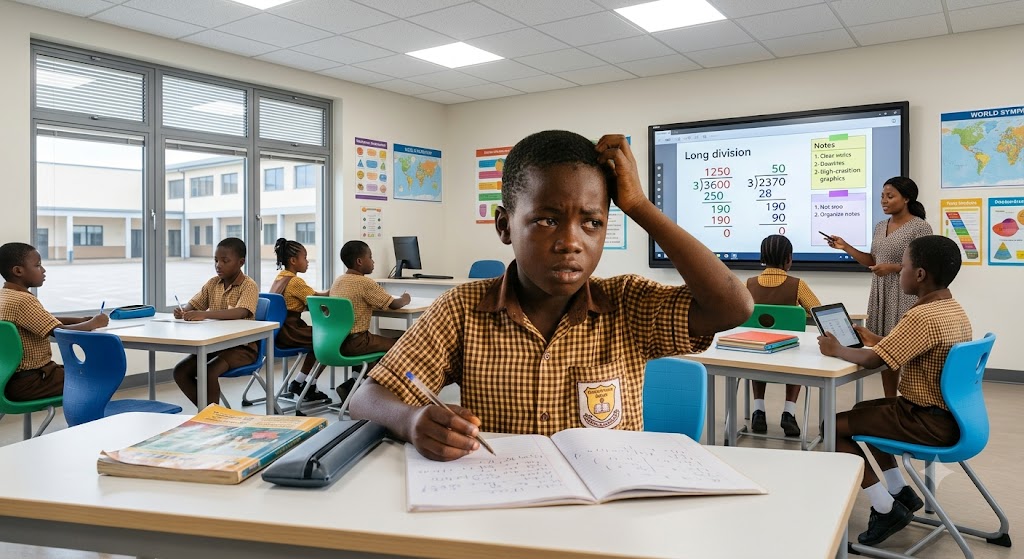
You pick your child up from school, ask them what they learned today, and get one of two answers: “Nothing” or a very confident explanation of something that sounds completely wrong. Sound familiar?
You are not alone, and your child is not being difficult. What you are witnessing is one of the most well-documented challenges in all of education. It even has a name.
Meet the Forgetting Curve
Back in the 1880s, a German psychologist named Hermann Ebbinghaus did something remarkably tedious in the name of science: he spent years memorising nonsense syllables and then testing himself to see how quickly he forgot them. What he discovered changed how we understand the human brain forever.
He found that without any kind of review or reinforcement, people forget roughly 50% of new information within the first hour of learning it. By the next day, that number climbs to about 70%. And within a week? Up to 90% of new material can simply vanish, as if it was never taught at all.
He called this the Forgetting Curve, and over a century of research since then has confirmed that it applies to children, adults, and everyone in between.
Here is the important thing to understand: this is not a memory problem. It is a reinforcement problem.
Why Classrooms Alone Cannot Beat It
Your child’s teacher is doing their best, but the odds are stacked against them from the start.
In a typical Ghanaian classroom, one teacher is responsible for 30, 40, sometimes 50 or more students at once. In that environment, it is simply impossible to slow down, go back, and make sure every single child has truly grasped a concept before the class moves on. The teacher teaches, the bell rings, and the lesson is filed away, whether it stuck or not.
And if a foundational concept does not stick? Everything built on top of it becomes shaky. A child who does not fully understand fractions in Class 4 will struggle with ratios in Class 5. A JHS student who is not confident in algebra will find themselves lost when the BECE questions arrive.
This is not failure. It is just the nature of how memory works, and it calls for a smarter solution.
The Fix Is Simpler Than You Think
Ebbinghaus did not just discover the problem. He also discovered the solution.
When he tested the same material at regular intervals (what researchers now call spaced repetition), the forgetting curve flattened dramatically. Each time you revisit a concept shortly after learning it, your brain treats it as important and holds onto it longer. Over time, that information moves from short-term memory into long-term storage, where it becomes knowledge your child can actually use.
The formula is not complicated: learn it, then come back to it, and come back again.
This is exactly the principle behind the way Class at Home structures its sessions.
How Class at Home Fights the Forgetting Curve
Rather than piling on more content for your child to absorb and forget, our approach is built around reinforcement at the right time.
Here is what that looks like in practice:
Weekday sessions (Monday, Tuesday, and Thursday) are held in the evenings, at 4:30 PM for Lower and Upper Primary students and 5:30 PM for JHS students. That timing is intentional. Your child has just spent the day in school. The concepts are fresh, even if fragile. Our tutors step in right at that window, before the curve starts its sharpest drop, and help your child actually consolidate what they learned.
Saturday sessions give families a different rhythm, with classes running across the morning and early afternoon at 10:00 AM, 12:00 PM, and 2:00 PM, each lasting one focused hour. For children who need a longer rest between school days before engaging again, or families whose weekday evenings are unpredictable, Saturdays offer the same quality of reinforcement without the pressure of a school-night schedule.
Both plans cover Maths, English, and Science, the three pillars of the GES curriculum that determine where your child stands academically and, ultimately, how they perform in the BECE.
What Makes the Difference: Focused Attention
Beyond timing, there is another reason Class at Home works where crowded classrooms struggle: our tutors can actually see your child.
In our sessions, there is no hiding at the back. No nodding along while secretly confused. Our tutors are trained to ask the right questions, spot the gaps, and slow down when something has not landed properly, without making your child feel embarrassed about it.
And when your child does understand something? That confidence has a way of following them back into the classroom. Students who know the material do not hide. They raise their hands.
READ ALSO: 10 Years of BECE Questions Analysed: What the Data Says Will Come Up – Class at Home
The Numbers Behind the Results
We do not just believe this approach works. We have seen it:
- Students who join Extra Classes gain an average of +16 points in their grades after switching from traditional, crowded after-school classes.
- Our structured schedule puts students 3 to 5 months ahead of their peers in curriculum coverage.
- Our online, interactive format keeps student engagement above 90%, compared to the constant distraction battles of a physical classroom.
These are not accidental outcomes. They are what happens when you combine the right timing, the right environment, and the right attention.
A Word for Busy Parents
We also know that you cannot always be the one to reinforce the lesson after school. You have your own work, your own exhaustion, your own evenings to manage. Sitting down to re-teach fractions at 7 PM is not realistic, and it should not have to be.
That is why our sessions come with recorded playbacks of every live class. If there is a power outage, a school activity, or your child simply needs to watch an explanation again, the lesson is always there. No lesson is ever lost.
And every so often, we share progress reports so you can see exactly where your child is improving. No guesswork, no waiting until end-of-term.
The Bottom Line
Your child is not forgetting on purpose. Their brain is doing exactly what brains do: letting go of information that has not been reinforced. The Forgetting Curve is real, it is powerful, and it is working against your child every single day that learning stops at the school gate.
The good news is that the solution is just as real. Structured, timely reinforcement delivered by patient, professional tutors who know the GES curriculum inside and out is what turns classroom lessons into lasting knowledge.
That is what we do at Class at Home. And right now, first-time families get GHC 50 off their first month, so there has never been a better time to start. Use the code FIRSTMONTH50 to claim your discount at checkout.
Ready to give your child a real edge? Sign up today and claim your GHC 50 discount
Class at Home offers expert-led extra classes for Primary and JHS students across Ghana. Sessions are GES-aligned, fully online, and available on weekdays and Saturdays.