
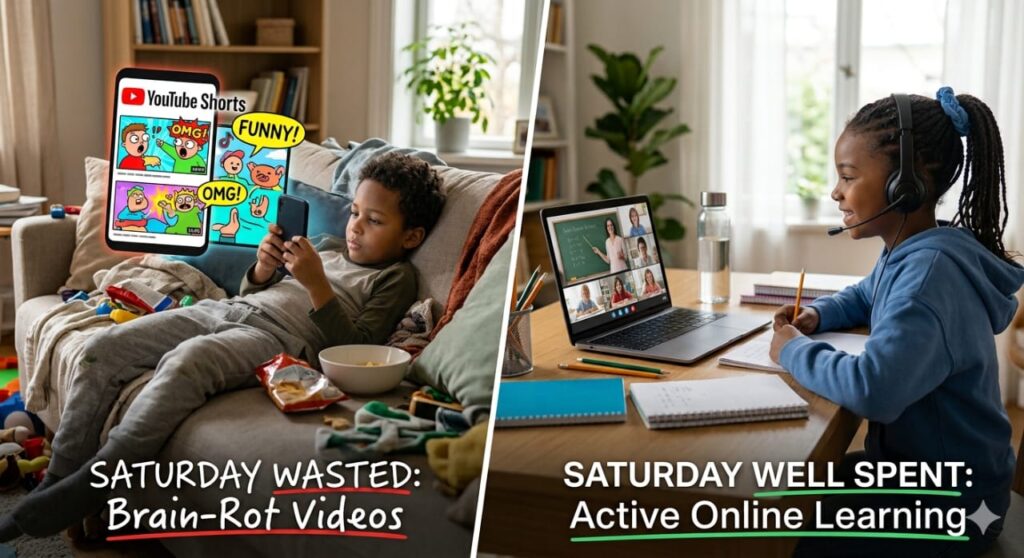
It is Saturday morning. You have had a long week. The last thing you want is a battle, so you let your child have the phone. Just for a little while.
Three hours later, they are still on it. Laughing at videos that make no sense, scrolling through content that disappears from their memory the moment the next one plays, speaking in sounds and phrases you do not recognise. They have not eaten properly, they have not moved, and if you ask them what they watched, they genuinely cannot tell you.
Sound familiar?
You are not a bad parent for letting it happen. But you are reading this because somewhere in the back of your mind, you know that something about it does not sit right.
What Is Brainrot and Why Should Ghanaian Parents Care?
Brainrot is not just a funny word teenagers use. It is the very real effect that hours of fast, low-effort content has on a developing brain.
When a child spends their Saturday watching 15-second videos back to back, their brain gets trained to expect constant stimulation with zero effort. Everything that requires patience, focus, or sustained thinking starts to feel boring and painful by comparison. Reading a textbook becomes unbearable. Sitting through a class feels like torture. Even having a proper conversation can feel like too much work.
Research from University College London found that heavy social media and short-video consumption in children aged 10 to 16 is linked to significantly shorter attention spans, reduced ability to retain information, and lower academic performance over time.
In Ghana, where your child’s entire future can hinge on how they perform in the BECE, this is not a small thing.
The Saturday Problem Nobody Talks About
Here is the reality of how many Ghanaian children spend their Saturdays:
Wake up late. Phone. Jollof if they are lucky. More phone. Maybe some TV. A little outdoor time if you push hard enough. Then back to the phone until it is time for bed.
And then Monday arrives and the week starts again, and Friday’s lessons are already half-forgotten, and Saturday did absolutely nothing to change that.
The problem is not that your child is lazy. The problem is that nobody gave them something better to do with that time.
Saturdays are actually one of the most valuable days of the week for a child’s academic development. There is no school pressure. No uniform rush. No tired teacher managing 40 other children at the same time. Saturday is the one day where learning can happen on the child’s terms, with energy, with focus, and without the chaos of a school week.
The question is whether you let that window go to waste.
READ ALSO: Home Tutors vs. Online Classes: Which Is Safer and More Effective for JHS Students in Ghana?
“But My Child Already Has Saturday School”
Some parents reading this will say: my child’s school already runs Saturday classes. So we are covered, right?
Not quite. And if you are honest with yourself, you probably already sense this.
Think about what Saturday school at a physical school actually looks like for most children in Ghana. Your child wakes up, puts on their uniform or “mofty”, and makes the trip back to the same building they just spent five days in.
The teacher standing in front of them is often just as tired as they are. The energy in the room is low. Attendance is patchy. And because it is Saturday, nobody, not the students and sometimes not even the teachers, treats it with the same seriousness as a regular school day.
What actually happens in many of those classes? The children sit together, chat, copy notes they may never read again, and wait for it to be over. The social energy of being back with friends on a weekend takes over completely. Learning becomes the background activity, not the main event.
This is not an attack on schools or teachers. It is simply the reality of what happens when you put children back into a school environment on a day their brains have already decided is not a school day.
The setting sends a message. And the message most children receive from Saturday school is: this does not really count.
Online is different, and not in the way you might expect. When your child logs on to a Class at Home session from their home, something shifts. There is no friend sitting next to them to whisper to. There is no back of the classroom to disappear into. There is no school gate energy telling their brain this is just an extension of the week. They are at home, they are comfortable, and the tutor’s attention is directly on them. They cannot coast. They cannot copy from the person next to them. They have to actually show up.
That accountability, in a relaxed and familiar environment, is what makes the difference between a Saturday that looks productive on paper and one that actually is.
What One Hour on a Saturday Morning Can Actually Do
At Class at Home, we built our Saturday programme around one simple idea: a focused hour at the right time is worth more than an entire afternoon of passive scrolling.
Our Saturday sessions run at 10:00 AM, 12:00 PM, and 1:00 PM, each lasting one hour. Primary and JHS students join small, interactive sessions covering Maths, English, and Science, all aligned to the GES curriculum.
One hour. That is all.
But here is what happens in that one hour. Your child is engaged, not passive. They are answering questions, not consuming content. A tutor is watching them specifically, not managing a crowd. And the material they cover is not new pressure piled on top of the school week. It is reinforcement of what they already learned, revisited at exactly the right time before it fades from memory.
That one hour on Saturday morning does more for your child’s academic development than four hours of scrolling will ever do. And it leaves the rest of the day completely free for them to be kids.
The Ripple Effect You Do Not Expect
Parents who enroll their children in our Saturday sessions often tell us they notice something they did not expect: their child starts the week differently.
Not just academically, though the grades do follow. But in how they carry themselves. Children who spend part of their Saturday doing something productive walk into Monday with a quiet confidence. They already revisited the work. They already know they understand it. The classroom is less intimidating when you are not walking in hoping nobody asks you a question you cannot answer.
That shift in confidence is not something you can buy with screen time. It comes from doing the work.
But What About Rest? Children Need Their Weekends Too
Absolutely. We agree completely.
One hour on a Saturday morning is not a sacrifice of your child’s weekend. It is an investment of the first hour, so the rest of the day can be genuinely free, guilt-free, and enjoyable. Your child is not losing their Saturday. They are earning it.
And because our sessions are fully online, there is no commute, no uniform, and no rushing. Your child logs on from home, attends a focused session, and they are done before most of their friends have even had breakfast.
What Brainrot Takes. What Learning Gives Back.
Here is a simple way to think about it:
Brainrot is passive. It takes your child’s attention and gives nothing lasting in return. Every hour spent scrolling is an hour the brain spent in neutral, not building anything, not growing anywhere.
Learning is active. Even one focused hour challenges the brain to work, to retain, to connect ideas. It builds the kind of mental stamina that makes everything else in life easier, including the BECE, secondary school interviews, and every classroom your child will ever walk into.
You do not have to choose between your child having fun on Saturdays and your child doing well in school. But you do have to be intentional about what their Saturdays look like.
Saturday Classes at Class at Home
Our Saturday sessions are open for Primary and JHS students. Sessions run at 10:00 AM, 12:00 PM, and 2:00 PM, each one hour long. Small groups, experienced tutors, GES-aligned content, fully online.
First-time families get GHC 50 off their first month with the discount code FIRSTMONTH50
One Saturday. One hour. That is all it takes to start changing the pattern.
Book your child’s first Saturday session today. Sign up here and claim your GHC 50 discount
Class at Home offers expert-led extra classes for Primary and JHS students across Ghana. Sessions are GES-aligned, fully online, and available on weekday evenings and Saturdays.